 Chiho AI
Telegram Support Escalation: From First Report to Next Update
To escalate a Telegram support issue, record the customer impact, preserve the minimum evidence needed to investigate, get an explicit acceptance from the next owner, and agree when the customer will hear from you again. Forwarding a message is only the start: the escalation is incomplete until someone accepts the next action and the update deadline.
This guide gives teams a reusable escalation brief, decision examples, and a closure checklist. It is a suggested operating procedure, not a claim that Chiho provides an automated ticket-routing or incident-management system. All people, messages, and timings in the worked example are fictional.
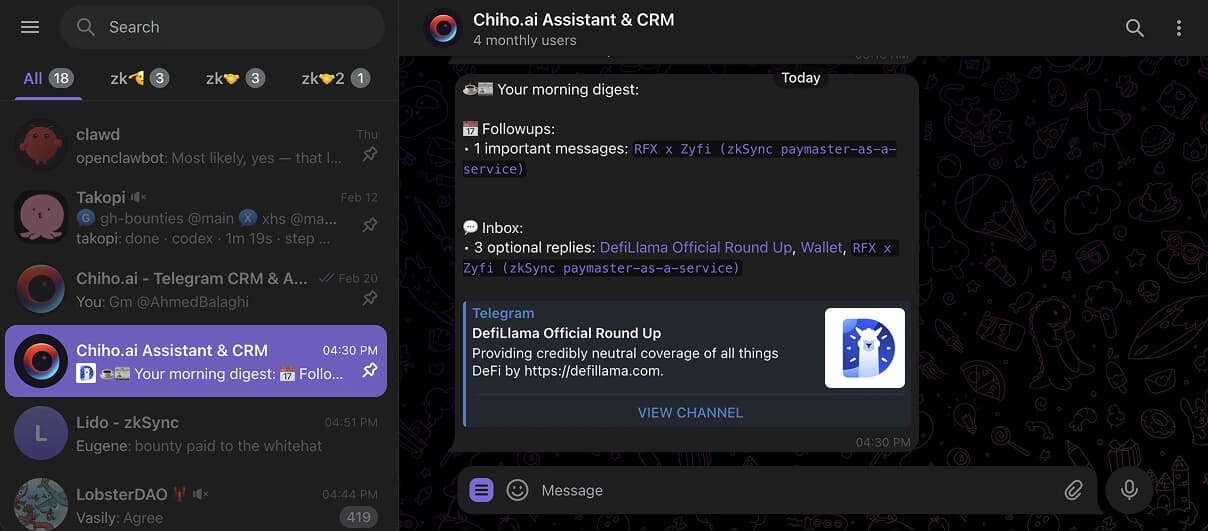
Image: an existing Chiho Telegram digest example. It illustrates the conversation environment, not an escalation dashboard or the fictional case below.
Decide whether the issue needs escalation
Escalate when the person handling the conversation cannot safely complete the next action with their current knowledge, access, or decision authority. The trigger should describe what changed for the customer, not how many messages they sent.
Use these example categories as a starting point, then adapt them to your actual service commitments:
- Blocked work: The customer cannot complete a necessary operation and has no confirmed workaround. Ask the appropriate technical owner to investigate and agree an update time.
- Limited impact with a workaround: Record who is affected and what the workaround does not cover. Agree a review time without implying that a permanent fix is scheduled.
- Decision outside the responder's authority: A refund exception, contract change, or delivery promise needs the person authorized to decide. Send a precise decision request, not a vague “please help.”
- Unclear report: Ask a focused question before choosing a technical route, unless the reported impact already warrants urgent attention. Record uncertainty explicitly.
A severity label describes the team's assessment; it does not establish a guaranteed response time. If your organization has a separate urgent-incident process, follow it. Do not wait for a normal Telegram handover to substitute for that process.
For example, “export failed for one user, another user has not tried it” supports a narrower conclusion than “all exports are down.” Distinguish the customer's report, your own observations, and hypotheses in the escalation brief.
Build a brief the next owner can act on
Keep the brief in a place both the current and proposed owner are authorized to access. A CRM note can hold a concise summary; a restricted case record may be more appropriate for sensitive evidence. Avoid copying an entire conversation when a short excerpt and source reference are enough.
Copy these fields into your team's chosen record:
- Conversation: Connected account, customer or team, and exact chat reference. Add the relevant message reference and its timestamp with timezone.
- Impact: What the customer cannot do, who is affected, when it began, and whether a workaround is confirmed.
- Evidence: The customer's exact symptom, a minimal redacted error excerpt, and any reproduction steps actually attempted.
- Known and unknown: Separate verified facts from assumptions; list the missing fact that would change the next decision.
- Requested action: One concrete investigation or decision, with the information needed to perform it.
- Investigation owner: Proposed person, acceptance status, and acceptance time once confirmed.
- Customer contact owner: The person responsible for the next customer update, even if another person is investigating.
- Next checkpoint: Date, time, timezone, and what should happen if there is no answer by then.
- Closure condition: What evidence would show that the issue is resolved, or that it should move to a different state.
Never add passwords, sign-in codes, access tokens, or unnecessary personal details to a shared brief. If evidence must stay restricted, describe how the authorized investigator can obtain it. A link alone is not proof that the receiving teammate can open the source: check access before treating the handover as complete.
The team handover guide covers the broader context-transfer process. For an escalation, the additional requirement is a specific unresolved question and an accepted next step.
Worked example: a blocked export
The following case is synthetic and demonstrates the record, not measured product behavior or a customer outcome.
At 09:10 Singapore time on 18 September 2026, a customer reports that an export for their monthly review returns an error. The support responder has not reproduced it. The customer says their review begins at 15:00; that is the customer's deadline, not a promised fix time.
A useful brief could read:
Case: EXAMPLE-018; Acme operations chat, connected support account; customer message at 09:10 SGT on 18 September 2026. Source reference retained in the authorized conversation record.
Impact: One customer reports a blocked monthly export. Number of affected users unknown. No workaround confirmed.
Evidence: Customer reports “export could not complete.” We have asked which export view and date range they used. No reproduction performed yet.
Request: Investigate the failure and determine whether a supported workaround exists. Do not commit to a repair time until assessed.
Owners: Maya keeps customer communication. Leo is the proposed investigator; acceptance pending.
Checkpoint: Maya checks acceptance at 10:00 SGT. Customer update due at 11:00 SGT, even if investigation is incomplete. If Leo cannot accept, Maya contacts the backup owner defined by the team's process.
Closure: Record the verified outcome and ask the customer whether the required export now works. If only a workaround works, keep the permanent issue separately tracked.
The acceptance step should change the record. If Leo replies at 09:35, “I can investigate; I will give Maya an assessment by 10:45 SGT,” record that commitment. Until then, Maya still owns routing the issue. The proposed investigator's name is not evidence of acceptance.
Separate the customer update from the investigation
An internal checkpoint and a customer promise serve different purposes. Leave enough room between them for the contact owner to read the findings and prepare an accurate reply. The example times above are illustrative, not recommended service levels for every team.
Before sending, a possible acknowledgment for this fictional case is:
Thanks for reporting the export error. We understand that you need the export for your review today. We are checking the issue and will update you by 11:00 Singapore time, even if the investigation is still in progress. Could you confirm the export view and date range you used?
Use that wording only if your team can honor the update commitment. If you have not started checking, do not say that you have. If there is no confirmed fix time, state that plainly rather than translating an internal guess into a promise.
At the update deadline, communicate what is known, what remains uncertain, and the next agreed checkpoint. If the investigator has not replied, the contact owner should still manage the customer update and route the internal delay through the team's backup process. Silence from the investigator does not cancel the customer commitment.
The message template guide provides more examples. Recheck the recipient, source facts, timing, and current conversation before using any template.
Use Chiho for context and follow-up, with explicit boundaries
Chiho's current implementation supports CRM notes and scoped follow-up tasks. Its hosted agent tools include adding tasks with a reason and due time, listing due or overdue tasks, and marking tasks complete. Team grants are restricted to team-visible accounts and dialogs. These are useful building blocks for an escalation record; they do not, by themselves, prove that a teammate accepted responsibility or that a customer received an update.
These capability statements were checked against Chiho's source and hosted agent documentation on 18 September 2026. They are source verification, not a live two-account support test.
A practical mapping is:
- Keep the short issue summary and evidence reference in the appropriate CRM note or authorized case record. Check whether you are working in personal or team context.
- Create a follow-up for the next checkpoint with an explicit date and timezone. Put the action in the reason, such as “Check investigator acceptance and prepare the customer update.”
- Record owner acceptance manually in the shared brief. Treat the investigation owner and customer contact owner as process roles, not as an automatic assignment claim.
- At the checkpoint, verify the current conversation and investigation result before drafting an update.
- Complete the follow-up only when that action is done. If the underlying issue remains open, retain its next action and checkpoint separately.
The hosted due-task list currently uses the end of the UTC day as its cutoff. For this procedure, verify the explicit due timestamp and your local timezone rather than treating the word “today” as a local-time deadline guarantee. A stored task also does not establish that an alert was delivered or that someone acknowledged it.
If an AI agent helps, begin by asking it to prepare a brief from a specified, authorized conversation and mark unknowns. Review the result against the source. Adding a task or sending a message is a write, and Chiho does not require a separate approval for every agent write: single-message sends and task changes can execute directly after any client-side controls. Use the AI-agent connection guide to understand permissions, and the message approval guide for the workflows that use approval queues. A request to draft should clearly say whether any saving or sending is authorized.
Close the loop without erasing uncertainty
Before closing the case, check four things:
- Outcome: What changed, and what evidence supports it? “Engineer marked complete” and “customer confirmed success” are different observations.
- Communication: What update was actually sent, by whom, and when? A prepared draft is not a sent message, and a sent message is not proof it was read.
- Remaining work: Is a workaround temporary? Does a different issue remain? Give each open action a checkpoint instead of hiding it in a completed task.
- Reopening: Where should the next responder find this brief if the symptom returns?
If the customer does not reply, record “awaiting customer confirmation,” or apply your team's documented closure policy with that limitation visible. Do not invent confirmation to clear the queue.
Rehearse one escalation before using it broadly
Use a fictional conversation and your team's own access rules. Ask a teammate to work from the brief without additional explanation. Can they identify the exact issue, open the permitted evidence, accept or reject the requested action, and name the person responsible for the next customer update?
Then test three exceptions: the proposed owner is unavailable, the source is inaccessible, and the update deadline arrives without a diagnosis. The exercise succeeds when each exception has an explicit next action; it does not require a fabricated resolution or a real customer message.
For a broader product evaluation, start with the Telegram CRM guide. To try this workflow in Chiho, create an account and prepare one controlled escalation brief with a teammate. Check context, access, and follow-up behavior before relying on it for a live support commitment.